What to Post About Your Book When You Have No Idea Where to Start
You sit down to post something. You open the app. And you just stare.
You draft a caption, hate it, delete it. Maybe you post something generic just to have something out there. A photo of your coffee and your manuscript. "Working on chapter twelve." And then you close the app feeling like you've failed at something you can't quite name.

So you go looking for more content ideas. You download the templates, save the caption prompts, follow the accounts that promise to tell you exactly what to post. And for about a week, it helps.
Then you're back at the blank screen.
Here is what's actually going on, and it has nothing to do with creativity.
This Is a Clarity Problem, Not a Creativity Problem
The blank screen is not a signal that you're bad at marketing. It's a signal that you're sitting down to create content without knowing two specific things: who your content is for, and what it's supposed to do for that person.
Without those two things, every post is a guess. And guessing is exhausting, especially when you're also writing, working, and trying to live your actual life.
The authors who always seem to know what to post are not more creative than you. They haven't found some magical source of endless ideas. They've done one specific piece of foundational work that most authors skip entirely.
They've identified their core messages.
What a Core Message Actually Is
A core message is one repeatable idea that connects your book to the reader who needs it. Not a plot summary. Not a generic topic. Not a quote from the book. A specific angle that is true and important about what your book does for the person who reads it.
Most authors have somewhere between 10 and 15 of them. And once those are identified and written down, you never start from zero again. Every post you create from that point forward is just a new way of expressing something you already know you need to say. You are not inventing content anymore. You are communicating what already exists.
Without core messages, every single post is a blank page. Every week. That is not a discipline problem. That is a foundation problem.
Here is what this looks like in practice so it stops being abstract.
If you write contemporary romance, say your book is about second chances, small-town settings, and heroines who don't need saving, your core messages are not "my book is out now" or "here's my cover." Your core messages are things like: why second-chance romance hits differently than first-love stories. Why heroines who save themselves are more satisfying than heroines who get rescued. What small-town settings do for the emotional intimacy of a love story that city settings cannot replicate.
Those are ideas your ideal reader has strong opinions about. They will stop scrolling for those. They will save those. And when they see you talking about them consistently, they will follow you, not because they found out about your book, but because they recognize you as someone who understands exactly what they are looking for as a reader.
If you write nonfiction, say a book about helping working parents reclaim their time, your core messages are not "here are five productivity tips." They are things like: why productivity systems designed for childless CEOs fail working parents. What happens to your relationship with your kids when you are constantly behind. Why the guilt of not having enough time is the symptom, not the actual problem.
Those messages speak directly to the reader your book was written for. They feel personally addressed. They feel understood. And when someone feels understood, they want to know who is talking to them and what that person wrote.
That is the difference between content that gets scrolled past and content that builds an audience that actually buys.
What Every Week Without This Is Costing You
Every week you post without knowing exactly who your reader is and what they need to hear, you are not building anything. The right readers are not finding you. Your email list is not growing. And whether your book is already published or you are still writing it, that is another week of real effort that is not compounding into anything.
The effort is there. It has just been missing the foundation that makes it work.
If you want to know exactly which pieces of your marketing foundation are missing, the free Book Marketing Blueprint will show you in about 15 minutes.
How to Find Your Core Messages
Start with three questions. Who is your ideal reader? What does your book give that specific person? And what do they need to hear over and over to trust you enough to buy?
Most authors cannot answer those questions clearly yet, and that is not a failure. That is simply where the work starts.
For fiction authors, pull your core messages from the emotional experience your genre creates, the tropes your readers feel strongly about, and the themes at the heart of your story. For nonfiction authors, pull from the specific problem your ideal reader is living with, what they have already tried that has not worked, and the transformation your book actually delivers.
Aim for 10 to 15. Once you have them, you never need a blank content calendar again. Ten core messages, each expressed as an awareness post, a warming post, and a converting post, gives you 30 posts. Rotate those three times over 90 days and your content is planned. Most of your audience will not see every post you make, which means repeating the same core message with slightly different framing is not redundant. It is strategic consistency.
Why the Templates You've Downloaded Haven't Fixed This
This is the part worth sitting with.
The templates, the caption prompts, the content calendars you've downloaded, they skip the foundation. They hand you a bracket that says something like "insert your unique value proposition here" and assume you already know what goes inside it. If you knew that, you would not have downloaded the template in the first place.
That frustration is real. And it is exactly why the foundation work has to come first, before any template, before any content calendar, before any of it.
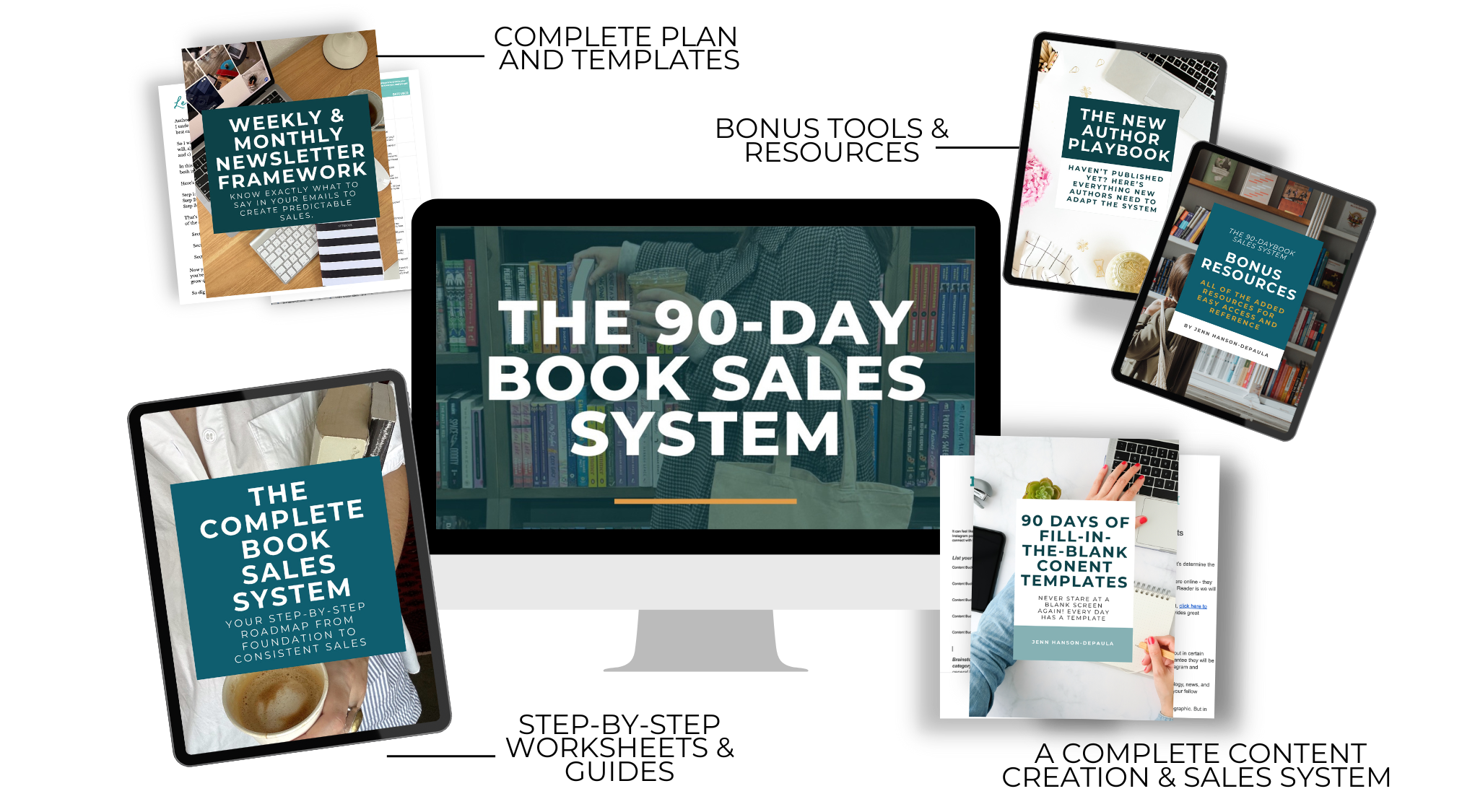
The 90-Day Book Sales System is built specifically around this sequence. Before you touch a single template or fill in a single day on your content calendar, the System walks you through your foundation. Your ideal reader. Your magnetic message. Your core messages. By the time you reach the content planning section, you are not guessing at what goes in it. You already know. The templates show you where to put the answers you have already found. That is a completely different experience than staring at a bracket and hoping something comes to you.
Where to Start Right Now
If the blank screen has been your reality, you do not need more post ideas. You need to do the foundation work that makes every post feel obvious instead of impossible.
Start by identifying your ideal reader specifically enough that you could describe them in a paragraph. Then define what your book gives that person. Then write down the 10 to 15 ideas they need to hear over and over to trust you enough to follow, engage, and eventually buy.
That work changes everything that comes after it.
If you want a clear picture of where your specific gaps are, the free Book Marketing Blueprint is the fastest place to start.
And when you are ready to build the full foundation and the content system around it, the 90-Day Book Sales System walks you through every step.